
You have the date, the venue, and the budget. What you still need is a shortlist of people who built the thing they talk about, plus a way to tell which of them can hold a 9am main stage the morning after a sponsor party.
Below are 18 speakers Silicon Valley Speakers works with and would put in front of a business conference audience right now. Every entry carries a credential we can source, the event type it fits, and the fee the speaker publishes on their own page. Where a speaker has chosen not to publish a number, this guide says "on request" rather than guessing one. Last updated October 19, 2026.
The short answer: a business conference speaker earns the fee by changing what the audience does the following Monday, which means operating experience, real customization, and strength in the format you actually booked. Six of the 18 speakers below publish a starting figure on their own page, from $5,000+ to $10,000+. The other twelve quote on request, because publishing a fee is the speaker's decision and not ours. Our own closed bookings run from $1,500 to $60,000.
What's in this guide
- The 18 speakers at a glance
- What a business conference speaker actually has to do
- What is different about hiring business conference speakers in 2026
- Business conferences vs business summits vs industry conferences
- How much do business conference speakers cost in 2026
- Business conference speakers by budget
- How to evaluate a business conference speaker before you book
- Matching business conference speakers to event types
- Where to find business conference speakers
- How to measure ROI on a business conference speaker
- Booking direct vs working with a speaker bureau
- Frequently asked questions
The 18 business conference speakers to know in 2026
These are the 18 speakers, ordered by the kind of room each one is built for. Fees shown are what the speaker publishes on their own profile page.
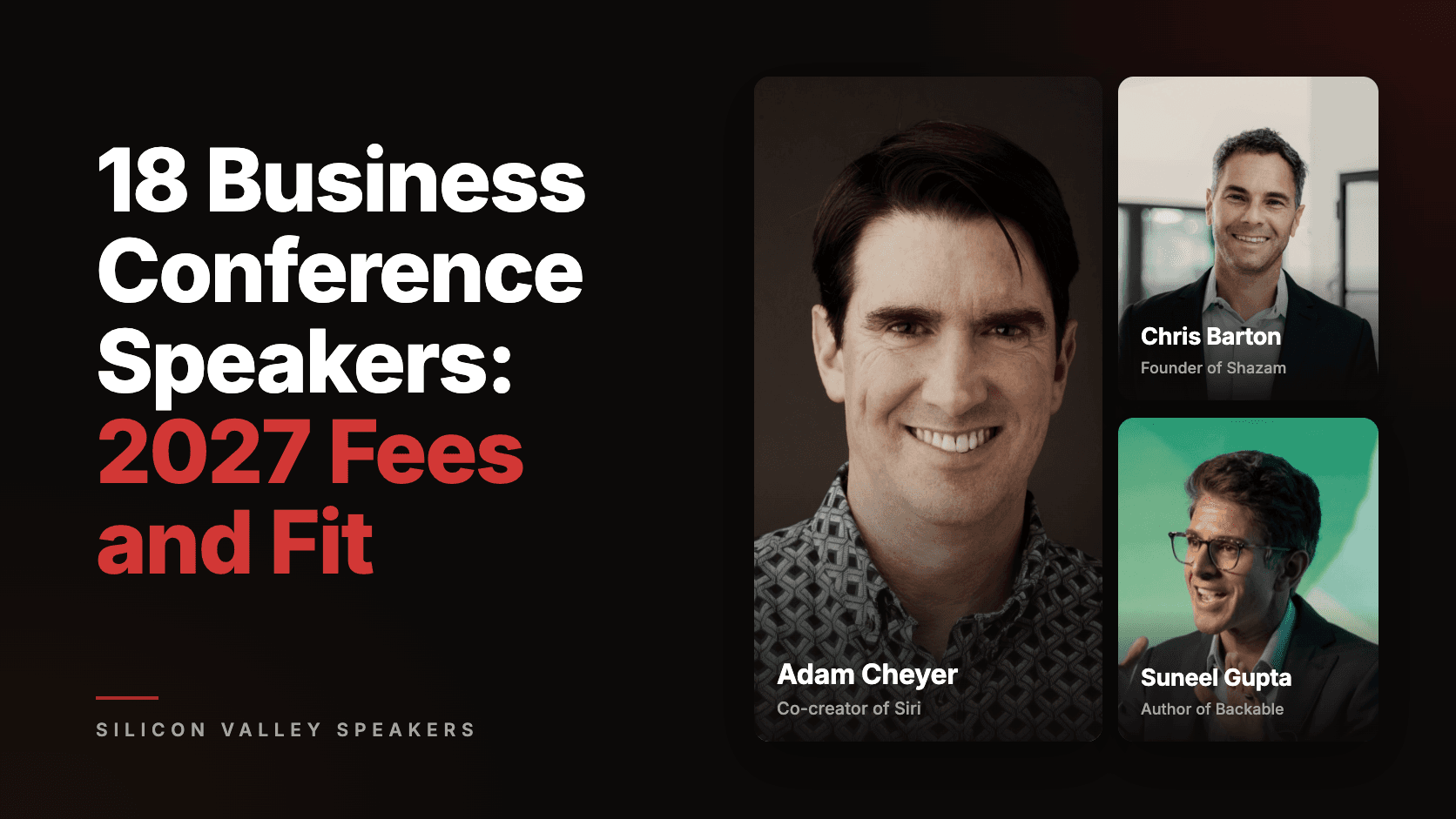
- Adam Cheyer: co-created Siri, now running on more than 2 billion Apple devices. Holds 50+ patents in AI, machine learning and conversational interfaces, published 60+ research papers, and founded five startups, four of which were acquired. Main-stage keynotes and leadership retreats. Fee on request.
- Chris Barton: founder and first CEO of Shazam, acquired by Apple for roughly $400 million after 2 billion downloads. Holds 12 patents, including one integrated into Google's search algorithm, was Google's first head of mobile relationships, and joined Dropbox inside its first 100 employees. Business and entrepreneurship conferences. Fee on request.
- Suneel Gupta: founding CEO of RISE, acquired by One Medical Group and now part of Amazon. International bestselling author of Backable, translated into nine languages, and a visiting scholar at Harvard Medical School. Named "The New Face of Innovation" by the New York Stock Exchange. Leadership conferences and annual meetings. Fee on request.
- Nicole Malachowski: first woman pilot on the USAF Thunderbirds, flying as Thunderbird #3. Flew 188+ combat hours as an F-15E flight commander, commanded the 333rd Fighter Squadron and its $1.1 billion in resources, and served as a White House Fellow. Inducted into the National Women's Hall of Fame. Association annual meetings and leadership conferences. Fee on request.
- Abigail Posner: spent 13 years at Google, most recently as Director of U.S. Creative Works, where she led AI-powered advertising strategy for YouTube's largest global advertisers and guided cultural change across Google's 4,000+ sales professionals. Magna cum laude Harvard graduate in social anthropology. Marketing and creative conferences. Fee on request.
- Philip Lakin: Director of AI Transformation at Zapier and co-founder of NoCodeOps, which Zapier acquired in 2024. Has logged 1,000+ hours in the field with enterprise AI leaders and been booked by Gartner on the human side of AI adoption. Annual conferences with workshop-heavy agendas. Fee on request.
- Zach Rattner: CTO and co-founder of Yembo, with 30+ granted US patents, AI running in 20+ countries, and 5,000+ professionals trained. Teaches AI proficiency for AICPA & CIMA and wrote Grow Up Fast. Startup and industry conferences. $10,000+.
- Mo Tiwari: AI researcher at Google DeepMind, previously a member of technical staff at OpenAI. Stanford CS PhD advised by Sebastian Thrun and Chris Piech, 3,100+ Google Scholar citations, and a co-author with Turing Award winner Yoshua Bengio. Industry conferences and innovation summits. $10,000+.
- Maya Ackerman: CEO and co-founder of WaveAI and AI professor at Santa Clara University. PhD in computer science from the University of Waterloo, postdoctoral fellowships at Caltech and UC San Diego, and 50+ peer-reviewed publications carrying 1,500+ citations. Business summits with senior technical audiences. $10,000+.
- Shannon Rowbury: first woman in US history to medal in the Olympic 1500-meter race, three-time Olympian, two-time World Championship bronze medalist and six-time US champion. Created the Medalist Mindset program and has keynoted for Abbott, Microsoft, Strava, Cyera and Lloyds Bank. Sales kickoffs and team all-hands. $10,000+.
- Drue Kataoka: visual generative AI artist and a Young Global Leader and Cultural Leader at the World Economic Forum. Won the 2025 Women in Generative AI Innovator Award and has keynoted at Davos, the Milken Global Conference, and the Pontifical Academy of Sciences at the Vatican. Business summits and leadership retreats. Fee on request.
- Matthew Spence: four-time finisher of the 29029 Everesting Challenge and a leadership developer for 25+ years at Meta, Nike, Levi Strauss & Co. and Collibra. Principal at ProjectNext Leadership and author of Lessons from the Wall. Sales kickoffs and leadership offsites. $10,000+.
- David Homan: USA Today best-selling author of Orchestrating Connection and founder of a private global network of 2,800+ vetted connectors. Has keynoted, moderated or emceed 350+ events across the US, Canada, the UK and Europe. Networking-heavy conferences and investor events. Fee on request.
- Ethan Monkhouse: founder of AI advisory firm Monkhouse & Partners and Partner and Head of AI at Knightox, who runs his own companies on the AI systems he builds. Client work spans UBS, Checkout.com, Audi, Lexus, Dell and the Government of Ireland. Business strategy conferences and AI adoption tracks. Fee on request.
- Milly Tamati: founder of Generalist World, built from a Scottish island with 191 residents into a bootstrapped business with 47,000+ newsletter subscribers and 700+ paid members, plus brand partnerships with Notion, Canva, Zapier, Reddit and Lovable. Entrepreneurship conferences, and strong as an event MC. Fee on request.
- Bryan McCann: member of technical staff at Anthropic, co-founder and former CTO of you.com, and lead author of CTRL, the first large-scale language model to undergo external ethical review before release. Deep-tech industry conferences and R&D events. Fee on request.
- AJ Eckstein: founder and CEO of Creator Match, a LinkedIn Learning instructor who has taught 150,000+ students, and a LinkedIn Top Voice for Hiring. Entrepreneurship conferences and marketing-heavy agendas. Fee on request.
- Noah Cheyer: built custom AI tools now used by more than 2,000 event professionals worldwide, after helping launch Speak About AI and booking AI experts for Fortune 100 companies. Event-industry and association conferences. $5,000+.
Business conference speakers at a glance: fit and fee
| Speaker | Known for | Best-fit event | Published fee |
|---|---|---|---|
| Adam Cheyer | Co-created Siri, 50+ AI patents | Main-stage keynotes, leadership retreats | On request |
| Chris Barton | Founded Shazam, 12 patents | Business and entrepreneurship conferences | On request |
| Suneel Gupta | Founding CEO of RISE, author of Backable | Leadership conferences, annual meetings | On request |
| Nicole Malachowski | First woman USAF Thunderbird pilot | Association meetings, leadership conferences | On request |
| Abigail Posner | 13 years at Google, Director of U.S. Creative Works | Marketing and creative conferences | On request |
| Philip Lakin | Director of AI Transformation at Zapier | Annual conferences, workshop-heavy agendas | On request |
| Zach Rattner | CTO of Yembo, 30+ patents | Startup and industry conferences | $10,000+ |
| Mo Tiwari | Google DeepMind researcher, Stanford CS PhD | Industry conferences, innovation summits | $10,000+ |
| Maya Ackerman | CEO of WaveAI, AI professor at Santa Clara | Business summits, senior technical audiences | $10,000+ |
| Shannon Rowbury | First US woman to medal in the Olympic 1500m | Sales kickoffs, team all-hands | $10,000+ |
| Drue Kataoka | Visual AI artist, WEF Young Global Leader | Business summits, leadership retreats | On request |
| Matthew Spence | Four-time 29029 Everesting finisher | Sales kickoffs, leadership offsites | $10,000+ |
| David Homan | USA Today best-selling author, 350+ events | Networking-heavy conferences, investor events | On request |
| Ethan Monkhouse | Head of AI at Knightox, AI advisory founder | Business strategy conferences, AI tracks | On request |
| Milly Tamati | Founder of Generalist World | Entrepreneurship conferences, event MC | On request |
| Bryan McCann | Anthropic researcher, co-founded you.com | Deep-tech industry conferences, R&D events | On request |
| AJ Eckstein | Founder of Creator Match | Entrepreneurship conferences, marketing agendas | On request |
| Noah Cheyer | AI tools used by 2,000+ event professionals | Event-industry and association conferences | $5,000+ |
What a business conference speaker actually has to do
A business conference speaker earns the fee by changing what your audience does on Monday morning. Inspiration is a side effect; behavior change is the job. Four things separate the speakers who clear that bar from the ones who do not.
They built something. Chris Barton spent six years keeping Shazam alive while MIT and Stanford engineers told him the pattern recognition it needed was impossible. That story is his, not a paraphrase of someone else's case study, and an audience can hear the difference inside two minutes.
They customize. A speaker who delivers the same 45-minute talk everywhere is a performer rather than a partner. The planner who booked Chris Barton for Optus got a talk written for 7,000 employees launching a new innovation strategy, and the innovation director reported it "attracted the highest real-time attendance and engagement compared to any other speaker."
They leave tools behind. After a Matthew Spence session, a Salesforce attendee wrote out the two changes they were taking back: "continuing to raise the bar by channeling the team's energy into stretch assignments that turn tough challenges into deliberate growth," and "breaking the habit of over-planning and just taking action, even when it's imperfect." That is what a framework looks like once it has survived contact with a real team.
They fit the format. A main stage for 2,000 people and a 30-person working session reward different skills. Philip Lakin has logged 1,000+ hours in the field with enterprise AI leaders and is built for the second; Adam Cheyer's Visa Payments Forum 2025 keynote is the first. Booking either one into the wrong slot wastes the fee.
What is different about hiring business conference speakers in 2026
AI fluency is table stakes. In 2024, an AI speaker was the futuristic slot on the agenda. In 2026, planners expect a main-stage speaker to have a position on AI whether the event is about supply chain, sales enablement or benefits administration. Ethan Monkhouse is the clearest version of the shift: he runs Monkhouse & Partners and the AI practice at Knightox on the systems he builds himself, so the talk is an operations report rather than a forecast.
Audiences want the deployment story, not the potential story. After three years of ChatGPT and Claude inside the workday, "AI will change everything" earns an eye-roll. Zach Rattner has trained 5,000+ professionals and has AI running in 20+ countries, which is why an attendee at AICPA & CIMA ENGAGE 24 called him "the highlight of our conference." Mo Tiwari works at Google DeepMind and was previously at OpenAI, so he can say what is actually close and what is still a paper.
Workshops are moving onto main-stage agendas. More of the briefs we receive now ask for a keynote plus a breakout than for a keynote alone. Philip Lakin's Zapier executive AI workshop drew this from a VP of sales strategy at Experian: "The day I spent in the Zapier Executive AI Workshop led by Phil was the best executive event I have ever attended." If you want both halves from one person, ask for video of each format separately. Our guide to the difference between a keynote speaker and a workshop facilitator covers how the two roles diverge.
Hybrid is the default build. Most large business conferences now carry a virtual attendance option, which means your speaker works a live room and a camera at the same time. Ask candidates what they do differently for the remote audience. A speaker who has no answer has not thought about half your attendees.
Business conferences vs business summits vs industry conferences: which speaker fits which
Planners arrive at a page like this one from five different searches: business conference speakers, speakers for business summits, industry conference speakers, speakers for startup conferences, and speakers for entrepreneurship conferences. Those are related events with different rooms, and the right speaker changes with the room.
Speakers for business conferences
A business conference is the broadest format: multi-day, a main stage plus breakouts, and an audience mixing executives, managers and individual contributors. The main stages our speakers have worked in this format run from 1,700 people at SAP to 7,000 at Optus, and the speaker carries the through-line that ties the agenda together.
That rewards founders and operators with a point of view strong enough for 45 minutes on stage and durable enough to survive a follow-up workshop. Adam Cheyer is the clearest example of the speakers we work with: he co-created Siri, holds 50+ patents, and has founded five companies, four of them acquired. One software company's written feedback after his keynote: "He was FANTASTIC! ... some said it was the best keynote we have had to date – after 7 years!" Chris Barton brings the same builder's view from Shazam; a managing director at SAP said his keynote "completely captivated our audience of 1,700+ customers, partners, and employees." Suneel Gupta covers the leadership side, and the president of the Association for Advancing Automation called him "one of the highest-rated speakers we've ever had."

If the theme is still open, start there rather than with a name: the conference themes list is the most-read guide on the Silicon Valley Speakers blog.
Speakers for business summits
A business summit is smaller, more curated and more senior. The format is built around conversation rather than presentation: fireside chats, off-the-record sessions, working groups. Davos and the Milken Global Conference are this format at its extreme. The speaker has to field questions from people who already know the field, with no production value to hide behind.
Summits reward speakers who can drop the performance and have a real exchange. Maya Ackerman runs WaveAI, teaches AI at Santa Clara University, and has 50+ peer-reviewed publications behind her, which is why a principal program manager at Microsoft described her session as "Illuminating and thought-provoking. Highly recommended as a keynote speaker!" Drue Kataoka has keynoted at Davos, the Milken Global Conference, and the Pontifical Academy of Sciences at the Vatican, and she treats a summit audience as peers. Abigail Posner spent 13 years at Google and carries a Harvard social anthropology degree into the room; the Oslo Business Forum team said, "People really loved her presentation and everyone who met her pointed out what a great and positive person she was."
Summit speakers also need to be available for the pre-event briefing and the dinner afterward. At summit fees you are buying the whole presence rather than the stage time.
Industry conference speakers
Industry conferences are vertical events (insurtech, biotech, fintech, semiconductor, association annual meetings) where attendees share a technical baseline. A surface-level take gets a polite eye-roll from a room that does this work daily.
For AI-adjacent verticals, Mo Tiwari researches at Google DeepMind after a stint at OpenAI, holds a Stanford CS PhD and 3,100+ citations, and has co-authored with Yoshua Bengio. Zach Rattner holds 30+ granted patents and ships AI into 20+ countries, which plays well with industrial and enterprise audiences who want the unvarnished operating picture. Bryan McCann works at Anthropic and co-founded you.com, a combination deep-tech audiences rarely get in one person. Nicole Malachowski covers the non-technical keynote slot at association annual meetings: the founder of Troon called her "simply the best speaker we have ever had in 32 years! Period!"

Industry conference speakers are in heavy demand in AI, biotech and energy. For an event in the first half of 2027, start outreach now. The strongest candidates book six to nine months out.
Speakers for startup conferences
Startup audiences are skeptical by default. They have heard every disruption narrative. Speakers for startup conferences have to bring operational specifics: what worked, what failed, what they would do differently with the same money.
Zach Rattner's book Grow Up Fast: Lessons from an AI Startup gives a startup room a field guide on hiring early engineers, setting pricing and surviving the first large customer. Milly Tamati built Generalist World from a Scottish island with 191 residents into a bootstrapped business with 47,000+ newsletter subscribers and 700+ paid members, with no venture funding. A director of operations at Unlock VC said, "Milly was a fantastic addition to our summit. Her energy is infectious, her passion is palpable and her knowledge runs deep and wide." Both sit alongside the other founders we work with for startup and entrepreneurship events.
Speakers for entrepreneurship conferences
Entrepreneurship conferences lean broader than startup conferences: small business owners, solopreneurs, agency founders, creator-economy operators. This audience wants the version of the founder story where the early idea was bad and the path to product-market fit was ugly.
Chris Barton's Shazam story fits that brief. The company launched as a phone service three years before iTunes and nearly collapsed several times across six years until the App Store arrived in 2008. Today more than 300 million people use Shazam every month, and his talks walk through the specific decisions on both sides of that line.
Milly Tamati works here from the other end of the capital spectrum, with brand partnerships at Notion, Canva, Zapier, Reddit and Lovable built without institutional backing. AJ Eckstein founded Creator Match and has taught 150,000+ students as a LinkedIn Learning instructor, so he can give an entrepreneurship room a concrete path from personal brand to revenue. David Homan covers the relationship side: a USA Today best-selling author with 350+ events behind him, described by conference host Tobias Prestel of Prestel & Partners as a speaker where "the room turns their head when David begins to share his unique perspectives on Trust, Community, and Action."
How much do business conference speakers cost in 2026
Most fee guides publish tidy tiers with no source. Here is what we can actually document, as of October 2026.
What our speakers publish. Six of the 18 speakers above publish a starting figure on their own profile page. Noah Cheyer starts at $5,000. Zach Rattner, Mo Tiwari, Maya Ackerman, Shannon Rowbury and Matthew Spence each start at $10,000. The other twelve quote on request, which is the speaker's call rather than a bureau tactic: publishing a number constrains every negotiation afterward, and plenty of speakers decline.
What we have closed. Across our own completed bookings, twelve paid engagements closed between $1,500 and $60,000. The distribution is lumpy rather than clustered in a comfortable middle: seven closed under $15,000, two closed at exactly $15,000, and three closed at $45,000 or above, with nothing at all between $15,000 and $45,000. Those three top-end closes in 2026 were all the same speaker, Adam Cheyer, at $45,000, $55,000 and $60,000. One speaker, three bookings, so treat it as a ceiling rather than a market rate.
What the all-in number includes. The fee is not the invoice. For a speaker flying cross-country, add roughly $2,000 to $5,000 for travel and hotel; international travel can double that. Virtual delivery is usually quoted below the in-person fee. Ask for an all-in figure in writing before you sign, and ask whether the quote covers the pre-event call, a meet-and-greet, and recording rights, because each of those is separately negotiable.
For a deeper pricing breakdown, see our keynote speaker prices guide.
Business conference speakers by budget: who fits where
Budget is the first filter most planners apply, so here is how the roster maps onto it, using only the figures the speakers publish.
Starting at $5,000. Noah Cheyer is the one speaker on our roster publishing a figure at this level. He built the AI tools now used by more than 2,000 event professionals, which makes him a fit for event-industry and association conferences and for workshop-led agendas rather than a 2,000-seat main stage.
Starting at $10,000. Five speakers publish here: Zach Rattner, Mo Tiwari, Maya Ackerman, Shannon Rowbury and Matthew Spence. This is the range where you get a documented stage record and a working session attached to the keynote. Shannon Rowbury is the clearest case for a sales kickoff; a VP at Abbott reported that "The Medalist Mindset had my team using soundbites and mentioning lines from their talk the rest of the day."
Quoted on request. The other twelve, including Adam Cheyer and Chris Barton, quote per event. That is not a dodge: the quote moves with travel, format, audience size and recording rights, and for the headline names it also moves with how much the booking displaces. If you have a number, say it in the first email. We will tell you within the same thread whether it clears, rather than walking you through a roster you cannot book.
How to evaluate a business conference speaker before you book
Once you have a shortlist, six steps do most of the work. Our longer walkthrough on how to choose a keynote speaker goes deeper on each.
1. Start with the outcome, not the name. Finish this sentence before you email anyone: "After this talk, our audience will ___." If you cannot fill the blank, you are not ready to book. If you can, you now have a filter for every candidate.
2. Watch full-length video, not sizzle reels. A 90-second reel proves someone edits well. A full 30-minute talk proves they can hold a room. Ask for unedited footage from an event in the last 12 months.
3. Ask what they will do differently for your audience. A strong candidate asks you at least as many questions as you ask them: your team's current problems, last year's keynote, the tone of your CEO's opening remarks.
4. Check format fit. Match the format to the speaker's strength rather than the reverse. Several of our speakers deliver both keynotes and interactive workshops, and Philip Lakin and Matthew Spence are both stronger with a working session attached.
5. Talk to a past client you chose. Not the quotes on the website. Ask for the name and email of someone who booked them in the last 12 months, then call that person and ask what surprised them in both directions.
6. Confirm logistics in writing. Travel, AV, pre-event call dates, whether they stay for Q&A, recording rights, social policy. All of it is easier to negotiate before signature than backstage.
Matching business conference speakers to event types
Sales kickoffs. Peak-performance speakers and founder storytellers, with takeaways a rep can use on the next call. Shannon Rowbury built the Medalist Mindset program for this room, and she teaches specific performance tools rather than running on adrenaline. Matthew Spence works the same slot from four finishes of the 29029 Everesting Challenge plus 25 years developing leaders at Meta, Nike, Levi Strauss & Co. and Collibra Browse more options on our sales keynote speakers and peak performance pages, and if the theme itself is still open, our sales kickoff themes guide is the place to start.

Leadership retreats and offsites. Smaller, higher-trust rooms that want depth over entertainment. Adam Cheyer's first-principles material works here because the audience can interrupt and dig in. Drue Kataoka's visual AI work gives leadership audiences something tangible to hold onto, and Suneel Gupta brings the burnout-and-innovation angle: a senior vice president of HR at Campbell's said "Leaders commented that it was extremely impactful." Our leadership keynote speakers page lists the rest.
Annual conferences and customer events. A recognized name signals how seriously you take the event, which matters when customers are in the room. If the agenda also needs a working session on AI adoption, Philip Lakin pairs well with a headline keynote; a CIO at Miro put it this way: "Phil doesn't just talk about AI and automation; he gets your team doing it."
Team all-hands and company meetings. Resilience and culture speakers, aimed at re-energizing a distributed team. Shannon Rowbury's performance frameworks map onto quarterly targets, and the chief ethics and compliance officer at the United States Olympic & Paralympic Committee wrote, "Your resilience and positivity are something we can all learn from."
Innovation summits and R&D events. Technical depth that stays accessible. Mo Tiwari and Maya Ackerman both clear that bar, and Bryan McCann adds a researcher working at the frontier right now. Our AI keynote speakers page covers the wider list.
Association annual meetings. Attendees chose to be there, they are paying members, and the association's reputation rides on every speaker choice. Nicole Malachowski and Chris Barton both carry across company sizes: Barton's Shazam material applies whether the room runs a 5-person firm or a 5,000-person division, and a training manager at Genentech said of Malachowski, "It is 120 people saying you were the absolute highlight of the whole offsite."
Where to find business conference speakers
Our keynote speakers roster lists everyone we work with by topic, so you can shortlist before emailing anyone. Beyond one roster, there are four channels.
Speaker bureaus. A bureau keeps a curated roster and handles matching, contracts, travel and logistics. The useful ones ask about your audience and goals and come back with two or three names rather than 500. Commission is built into the speaker's fee rather than billed to you; across our own active roster the rate runs from 20% to 30% depending on the speaker. The trade-off is coverage: a bureau can only recommend the speakers it represents.
Speaker directories and marketplaces. Sites like AAE Speakers and Executive Speakers Bureau list thousands of speakers searchable by topic, fee and availability. Good for discovery, but the vetting is yours, and the listings stretch from former heads of state to regional motivational speakers on one page.
Direct outreach. Going direct rarely saves money. Most speakers quote the same fee either way, and many above $30,000 are exclusive to a bureau or their own management, so the inquiry gets forwarded anyway. You also absorb the contract and travel coordination yourself.
Referrals from other planners. The highest-signal channel by a wide margin. A planner who can tell you how the customization actually went beats any demo reel. Ask your network before you open another database.
How to measure ROI on a business conference speaker
Most planners get one chance a year to defend the keynote line item. Four signals survive that conversation.
Day one: the post-event survey. Ask for a 1 to 10 rating plus one specific action the attendee will take. The free-text answers are the real data. Response rates halve within a week, so send it the same day.
Day 30: behavioral indicators. Pick two metrics tied to the talk's theme before the event, then check them a month later. If the speaker covered AI deployment, did a team ship a pilot? You are looking for the speaker's language showing up in actual work.
Day 90: the recall test. Ask five random attendees what they remember. One articulated idea that changed a decision means the fee was earned. Blank looks mean it was not. The Abbott team quoted above was still repeating lines from Shannon Rowbury's talk at the end of the same day, which is the leading indicator for this test.
Registration and sponsor impact. For external-facing conferences, track registrations before and after the speaker announcement. A measurable spike makes next year's budget conversation short. The same logic applies to sponsors: did the name on the agenda help close a package?
Booking direct vs working with a speaker bureau
Booking direct is usually not cheaper, and plenty of speakers can only be booked through a bureau or their own management. We wrote a full comparison in speakers bureau vs booking direct; the short version is below.
When to skip the bureau. Under about $5,000, most bureaus will not take the booking, because the commission does not cover the work. Book those speakers yourself. Above that level, going around a bureau usually means chasing a speaker whose calendar that bureau manages anyway, at the same fee.
When a bureau earns its place. You need to narrow hundreds of options to two or three. You are booking multiple speakers across sessions. You want someone else owning contracts, travel, AV riders and day-of logistics. Or the speaker you want routes every inquiry through their representation, which is common once a founder is fielding dozens of requests a month.
What it costs you. Nothing additional. Most bureaus, including ours, are paid by the speaker out of the quoted fee. There is no separate planner-side charge. For more on running the whole process, see our guide on how to hire a keynote speaker.
Frequently asked questions about business conference speakers
What is the difference between a business conference and a business summit?
A business conference is larger and more open: multi-day, main stage plus breakouts, mixed seniority in the audience. A business summit is smaller and curated, with senior attendees, fireside formats and off-the-record working sessions. The speaker bar differs too, because a summit speaker fields real questions from people who already know the field. The same name will not always fit both: Adam Cheyer's main-stage keynote material is built for the first, while Drue Kataoka's Davos and Milken sessions are the second.
How far in advance should I book a business conference speaker?
For speakers publishing in the $10,000 range, three to four months is usually enough. For headline names quoting on request, plan on six to 12 months. If your event is in the first half of 2027, start now, because the strongest industry-conference candidates are booking six to nine months out as of October 2026.
Why do some speakers show a fee and others say "on request"?
Publishing a fee is the speaker's decision. Six of the 18 speakers on this page publish a starting figure; the other twelve have asked us not to, usually because the real number moves with travel, format, audience size and recording rights. We will not print a number a speaker has chosen to keep private, so "on request" means exactly that. Send us your budget and we will tell you who clears it.
Can I book a business conference speaker for a virtual event?
Yes. All 18 speakers on this page list virtual availability, but treat it as a separate format: a virtual talk needs a studio setup rather than a laptop on a stack of books, and the material has to be rebuilt for camera. Ask for a virtual demo reel separate from the in-person reel, because a strong stage speaker does not automatically translate to a remote room.
How do I find a speaker for an industry-specific conference?
Start with operating background rather than topic tags. An AI speaker who only comments on the field gets found out fast by a technical audience. Look for someone who has shipped in your industry or worked with companies in it. Mo Tiwari at Google DeepMind and Zach Rattner at Yembo are two versions of that test passing, from the research side and the product side.
What is the difference between a keynote and a workshop?
A keynote is one-to-many, usually 30 to 60 minutes from a main stage. A workshop is interactive, usually 90 minutes to a half day, with a smaller group and exercises. Several speakers do both, and pairing a keynote with a follow-up workshop within 90 minutes is one of the higher-return formats we see. Our keynote speaker vs workshop facilitator comparison covers how to brief each role.
What topics are business conference audiences asking for right now?
From the briefs reaching us in late 2026, AI strategy and implementation dominates, followed by leadership through uncertainty, sales performance, and resilience. The AI angle has shifted: planners now ask for deployment results rather than potential. Philip Lakin, Ethan Monkhouse and Zach Rattner all answer that version of the question, and the inspirational business speakers and motivational speakers for corporate events lists cover the resilience end.
Related reading:
- Conference themes that give an agenda a spine
- Speakers bureau vs booking direct
- How to choose a keynote speaker
- Keynote speaker prices
- How to plan a corporate event that delivers real results
- AI keynote speakers
- Leadership keynote speakers
Ready to book a speaker for your business conference? Send us the event date and the outcome you want, and we will come back with named speakers from the roster above and what each one costs all-in. Tell us about your event, and if you already have a budget number, put it in the first message so we can skip the speakers you cannot book.